Number Theory course home Number Theory course home Number Theory
  • Summary
  • Textbook
  • Lectures
  • Assignments
  • Exams
  • Grading
  • Resources
MATH 4400/6400 Fall 2026

Number Theory

“God made the integers; all else is the work of man.”
— Leopold Kronecker
Meetings MWF · 12:00 p.m.–12:55 p.m.
Boyd · 302
Instructor Dr. Steve Fan
Steve.Fan@uga.edu
Office hours MWF · 4:00 p.m.–5:00 p.m.
Boyd · 321C
About the course

Course summary

Number theory is the study of the integers (and related arithmetic objects) and the remarkable structures hidden inside them. It is one of the oldest and most beautiful branches of mathematics. Although its questions are often easy to state, many have resisted centuries of effort.

This course invites you on a journey into the classical theory of numbers, with particular attention paid to the pathbreaking accomplishments of the 18th and 19th centuries. Topics include divisibility, congruences, unique factorization, quadratic residues and quadratic reciprocity, Gaussian integers, prime numbers, arithmetic functions, and selected advanced topics and applications.

Along the way, we will emphasize proof writing, mathematical communication, and the transition from examples to general theorems.
View the course syllabus
Course materials

Recommended textbook

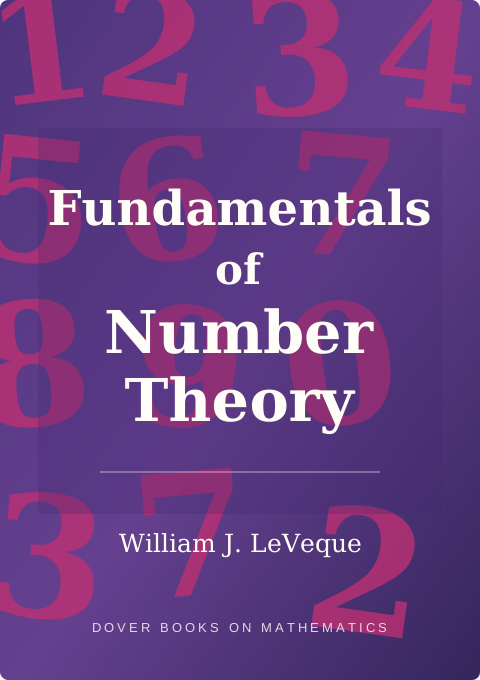
Cover of Fundamentals of Number Theory by W. J. LeVeque
Recommended · not required

Fundamentals of Number Theory

W. J. LeVeque

LeVeque's book covers the standard topics clearly and is remarkably inexpensive. You do not need the book for this course, but it is an excellent addition to any mathematical library.

Purchase
Updated after each class

Lectures

View all lectures →
September 9 Lecture 10

Quadratic reciprocity and its applications

quadratic reciprocityJacobi symbolsum of two squares
Notes
September 4 Lecture 9

The law of quadratic reciprocity

quadratic reciprocitycounting lattice points
Notes
September 2 Lecture 8

Gauss's lemma (cont.)

Gauss's lemma2 modulo p
Notes
August 31 Lecture 7

Gauss's lemma

Wilson's theoremfloor functionGauss's lemma
Notes
August 28 Lecture 6

Euler's criterion and its applications

quadratic residues & nonresiduesEuler's criterionLegrendre symbol-1 modulo p
Notes
August 26 Lecture 5

Quadratic residues and nonresidues

polynomial congruencesLagrange's theoremquadratic congruencesquadratic residues & nonresidues
Notes
Homework and due dates

Assignments

All assignments →

Homework will be collected in class, once every week or two. You are responsible for keeping track of the due dates of these assignments. Late homework will not be accepted. The lowest homework score will be dropped at the end of the term.

Collaboration is encouraged, but you must write your own final solutions independently and make sure that you understand and are able to explain every submitted argument if requested to do. Keep in mind that by entering UGA, you have already agreed to abide by the UGA Honor code described at https://honesty.uga.edu/Academic-Honesty-Policy/.

Homework 1 Aug. 31, 12 p.m.

Unique Factorization in ℤ and Congruences

Closed Open
Assessment dates and policies

Exams

There are two in-class midterm exams and a cumulative final exam. All exams are closed book and closed notes. The exam dates will be announced later.

Please keep in mind that no make-ups will be given, except when required by UGA policy or arranged for a documented emergency.

Midterm 1

Date
October 9
Time
12:00 p.m.–12:55 p.m.
Location
Boyd 302

Midterm 2

Date
November 13
Time
12:00 p.m.–12:55 p.m.
Location
Boyd 302

Final exam

Cumulative
Date
December 7
Time
12:00 p.m.–3:00 p.m.
Location
Boyd 302
How the final grade is calculated

Grading

Final grades will be calculated from the following weighted components.

HomeworkLowest homework score dropped
22%
Midterm 1In-class examination
24%
Midterm 2In-class examination
24%
Final examCumulative examination
30%
Support and access

Accommodations and resources

Special accommodations

Students who may require accommodations should contact the instructor as early as possible and work with the university office responsible for accessibility services. Appropriate documentation may be required under university policy.

University resources

Well-being ResourcesUGA well-being support → Student Care and OutreachNavigating personal or academic difficulties → University Health CenterConfidential mental-health and well-being support → Counseling and Psychiatric ServicesCAPS 24/7 crisis support at 706-542-2273 → Health Promotion/Fontaine CenterWell-being, early intervention, and prevention → Accessibility and TestingOn-campus accessibility and testing services →
Please note

The course syllabus is a general plan for the course and is subject to change; deviations announced to the class by the instructor may be necessary.

Back to top

© 2026 Steve Fan

 
  • Built with Quarto